Minmini Healthcare Digital Marketing

Uncategorized

Uncategorized

Why Traditional Digital Marketing Strategies Are Failing in 2026

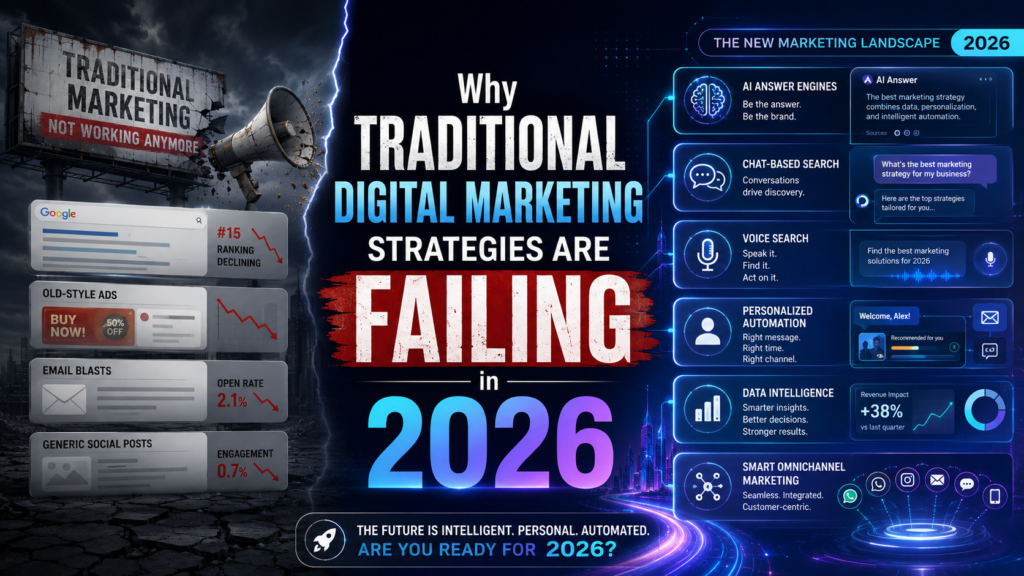
Why Traditional Digital Marketing Strategies Are Failing in 2026 Digital Marketing · 2026 Why Traditional Digital Marketing Strategies Are Failing in 2026 For more than a decade, digital marketing followed a familiar formula: publish keyword-focused blog posts, run narrowly targeted advertisements, collect as many leads as possible, retarget website visitors and measure success through traffic, impressions, clicks and last-touch conversions. That formula is no longer enough. AI DiscoveryHuman-Led StrategyFirst-Party Trust 200+AI Overview markets 40+Languages ≈15%Traffic impact studied Scroll to explore The old formula is no longer enough. In 2026, customers do not move through a simple marketing funnel. They discover brands through Google, AI assistants, social media searches, creators, review platforms, online communities, videos, marketplaces, podcasts and private recommendations. HubSpot’s 2026 marketing research notes that buyers increasingly explore social feeds, creator networks, communities, review sites and AI-generated answers rather than depending entirely on traditional search engines. Customers may evaluate a company without visiting its website until they are almost ready to purchase. In some cases, an AI-generated answer can summarize a business, compare its products or services and recommend the next action before the customer clicks a traditional search result. Traditional digital marketing is not dead. However, the traditional operating model—more content, more keywords, more advertisements, more tracking and more automation—is failing because it was designed for an internet that no longer exists. 01 ⌁ ANSWER ENGINES 1. Search Has Changed from a List of Links to an Answer Engine Traditional search engine optimization was built around winning one of the top organic positions for a target keyword. Marketers assumed that a higher ranking would produce more clicks, more website traffic and eventually more sales. In 2026, search engines increasingly answer questions directly. Google’s AI Overviews expanded to more than 200 countries and territories and over 40 languages. Google also reported that AI Overviews increased usage for the types of queries that triggered them in major markets such as the United States and India. This creates a serious challenge for traffic-focused marketing. A brand may appear inside an AI-generated response but receive fewer website visits because the user finds enough information directly on the search results page. A 2026 research study examining Google AI Overviews and Wikipedia estimated that exposure to AI Overviews reduced daily traffic to affected English-language Wikipedia articles by approximately 15%. The implication is important: search rankings remain valuable, but rankings alone are no longer the complete goal. Brands must now optimize for: Visibility inside AI-generated answers Brand mentions and citations Topical authority Customer trust Qualified website visits Conversions across multiple platforms The question is no longer simply, “Does our website rank first?” The better question is, “Is our brand present, trusted and recommended wherever customers are searching for answers?” 02 ◎ SEARCH INTENT 2. Keyword-Only SEO Cannot Understand Modern Search Intent Traditional SEO strategies often begin with a spreadsheet containing hundreds of high-volume keywords. Marketers then create separate pages for every keyword variation, question, service or location. That approach is becoming less effective because modern search systems understand context, meaning and related intent. Google explains that its generative search features can use “query fan-out,” generating several related searches to provide a more complete answer to a complex question. Google also states that website owners do not need to create a separate page for every long-tail keyword variation. A webpage cannot succeed simply because it repeats the correct phrase. It must demonstrate genuine relevance and address the broader problem behind the search. For example, a hospital page targeting “best knee replacement hospital” should not repeatedly insert the keyword into every paragraph. It should clearly explain: Who may require knee replacement Available treatment options Surgeon experience Diagnostic procedures Technology used Expected recovery time Potential risks Approximate costs Insurance support Follow-up care One comprehensive and trustworthy resource is more valuable than ten thin pages created for slightly different keyword variations. The new SEO question is not, “How many times should we use this keyword?” It is, “Does this page provide the clearest, most credible and most useful answer?” 03 ✦ CONTENT VALUE 3. Mass-Produced Content Has Become a Commodity The internet is flooded with articles, captions, emails, videos and advertisements created or assisted by artificial intelligence. HubSpot’s 2026 State of Marketing report says that 80% of marketers use AI for content creation and 75% use it for media production. The same report describes AI as a baseline capability rather than a genuine competitive advantage. When every business can produce 50 blog posts, 100 captions and multiple advertisement variations within a few hours, content volume stops being a differentiator. Generic articles such as “10 Tips for Better Marketing,” “Why Choose Our Company?” and “Top Benefits of Our Service” can be produced by almost anyone. Without original experience, customer insight, evidence, proprietary data or expert knowledge, this content struggles to earn attention, trust, backlinks or citations from AI systems. Google’s 2026 guidance for generative search specifically recommends unique, useful and non-commodity content. It warns against simply recycling existing information or producing pages at scale primarily to manipulate search visibility. The alternative is experience-led content, including: Original case studies Expert interviews Customer success stories Patient journeys Local market insights Detailed comparisons Original research Transparent business processes Lessons learned from real projects Behind-the-scenes explanations AI can accelerate the production process, but it cannot replace a company’s actual experience, evidence or point of view. Businesses that use AI only to increase content volume will add more noise to the internet. Businesses that combine AI with expertise will create information worth finding. 04 ◫ AD CREDIBILITY 4. Generic Advertising Is Losing Customer Attention Traditional digital advertisements frequently rely on broad claims such as: “Best Quality.” “Affordable Price.” “Trusted Service.” “Contact Us Today.” “Limited-Time Offer.” These statements are easy to publish but difficult to believe. Customers see similar claims from multiple companies every day. When an advertisement contains no clear differentiation, evidence or relevance, it becomes background noise. Meanwhile, advertising platforms are increasingly using artificial intelligence to match advertisements with audiences, search intent, creative assets

Uncategorized

AI in Healthcare: Benefits, Challenges & Future Trends (2026)

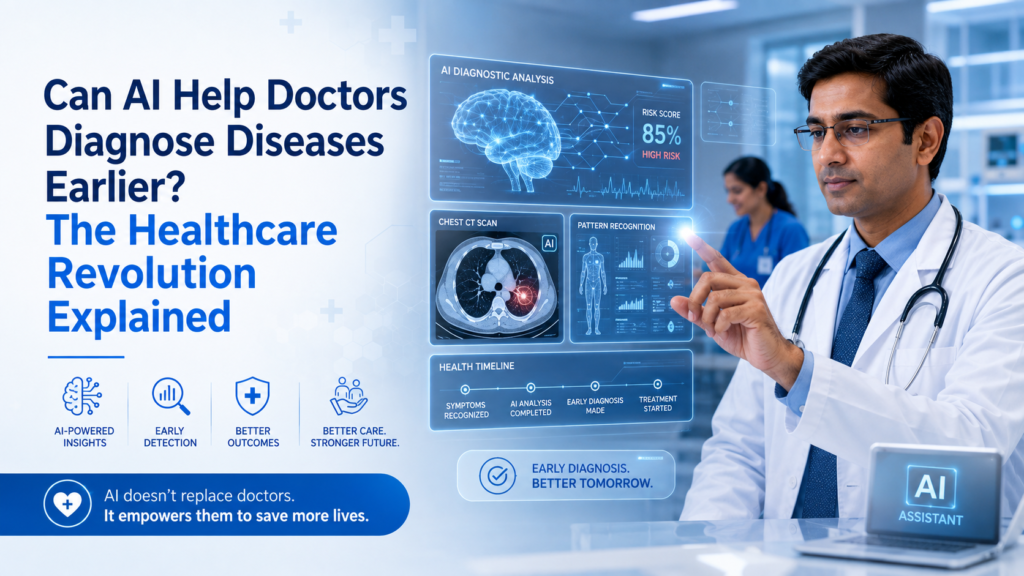
AI in Healthcare — The Future is Now Insight Series — 2025 The Intelligent Future of Medicine Artificial Intelligence is rewriting every rule of how we diagnose, treat, and care for human life — from the radiology suite to the patient’s wrist. 45B Market Size by 2030 97% Diagnostic Accuracy 4× Faster Drug Discovery Scroll to Explore 2.5ZB Health Data Generated / Year 86% Admin Waste AI Can Eliminate 30% Cost Reduction Potential $150B Annual AI Savings by 2026 01 Introduction Why AI Changes Everything in Healthcare Healthcare generates more data than any other industry on earth. The problem is that no human can process it fast enough to save lives. Artificial Intelligence is transforming industries worldwide, and healthcare is among the sectors experiencing the most significant impact. From improving diagnostic accuracy and streamlining administrative tasks to enabling personalized treatments and accelerating drug discovery, AI is revolutionizing how healthcare services are delivered. Healthcare organizations today face a convergence of unprecedented pressures — rising costs, increasing patient expectations, critical shortages of professionals, and an ever-growing deluge of medical data. Electronic health records, medical imaging, genomic sequences, wearable device signals — together they form an ocean of insight that traditional systems simply cannot navigate. AI does not replace the clinician’s wisdom, intuition, and empathy. Instead, it removes the noise, surfaces what matters, and gives clinicians the clarity they need to act — faster, with greater confidence, and with fewer catastrophic errors. This is not a futuristic vision. It is happening today. AI serves as a powerful support tool rather than replacing healthcare providers — enabling doctors and nurses to focus more on patient care while reducing repetitive and time-consuming tasks. — AI in Healthcare, Global Research Consensus 02 Key Benefits Eight Ways AI is Saving Lives Today From imaging suites to ICU beds, AI is proving its value across every corner of the healthcare ecosystem. 🔬 Improved Diagnostic Accuracy AI algorithms analyze X-rays, CT scans, MRIs, and retinal images — identifying subtle abnormalities that human eyes may miss, especially in early-stage diseases. 🧬 Personalized Treatment Plans By analyzing genetic information, medical history, and lifestyle factors, AI helps clinicians craft treatment strategies uniquely tailored to each patient. 💊 Faster Drug Discovery AI slashes years from pharmaceutical research by predicting drug candidates, analyzing molecular structures, and compressing clinical trial timelines. 📡 Enhanced Medical Imaging Radiology departments gain a tireless second reader — AI systems that highlight suspicious regions, prioritize urgent cases, and cut diagnostic errors. 📈 Predictive Analytics AI predicts cardiac events, sepsis risk, and patient deterioration — enabling clinicians to intervene before complications spiral out of control. ⚡ Administrative Efficiency Appointment scheduling, medical coding, billing, and documentation — AI automates the tedious, freeing staff to focus on human care. 🤖 Virtual Health Assistants AI-powered chatbots answer patient questions around the clock, schedule appointments, send reminders, and provide guided symptom assessments. 📲 Remote Patient Monitoring Wearables stream real-time health data to AI systems that alert clinicians the moment a patient’s vitals drift from safe thresholds. 03 Adoption by Specialty Where AI is Taking Deepest Root Some specialties have embraced AI far faster than others, driven by data availability and clinical urgency. Radiology & Medical Imaging94% Oncology & Cancer Care88% Cardiology81% Dermatology75% Administrative & Operations70% Mental Health52% 04 Applications AI Across the Clinical Spectrum Clinical Specialties RadiologyOncologyCardiologyDermatologyMental HealthPathologyOphthalmologyNeurologyGenomicsPediatricsEmergency Medicine Operational Areas Staff SchedulingClaims ProcessingBed ManagementMedical CodingDrug InventorySupply ChainPatient TriageClinical DocumentationReadmission Prediction 05 The Hard Truths Challenges That Must Be Conquered The road to AI-powered healthcare is not without obstacles. Recognizing them is the first step to overcoming them. 01 Data Privacy & Security Healthcare data is among the most sensitive in existence. AI systems require large datasets, creating attack surfaces that demand robust cybersecurity frameworks and strict patient confidentiality protocols. 02 Data Quality Issues AI is only as good as its training data. Incomplete, inaccurate, or inconsistent records lead to unreliable outputs — underscoring the critical importance of data governance. 03 Algorithmic Bias If historical training data contains demographic, racial, or socioeconomic biases, AI systems will perpetuate — and sometimes amplify — those disparities in patient care. 04 Regulatory & Compliance Hurdles Getting AI tools through clinical validation, regulatory approval, and ethical compliance is a long, complex process that varies significantly across jurisdictions. 05 Trust & Adoption Resistance Healthcare professionals may hesitate to act on AI recommendations due to perceived lack of transparency, fear of errors, or concerns about diminished clinical autonomy. 06 High Implementation Costs While AI reduces long-term costs, upfront investment in infrastructure, software, and staff training can be prohibitive for smaller healthcare organizations and developing health systems. 06 Ethics & Responsibility The Moral Compass of Intelligent Medicine 🔍 Transparency Clinicians must understand how AI systems arrive at recommendations — not just accept their outputs on faith. ⚖️ Accountability When AI-assisted decisions lead to adverse outcomes, clear lines of legal and professional responsibility must be established. 🤝 Fairness AI systems must provide equitable support across all patient populations, regardless of race, gender, or socioeconomic status. 🛡️ Patient Consent Patients have the right to know when and how AI is involved in their care — and how their personal health data is being used. 07 Looking Ahead Six Frontiers That Will Define Tomorrow The next decade of AI in healthcare will be defined by breakthroughs that are already in motion today. Generative AI Clinical Documentation Revolution Generative AI will create clinical notes, summarize patient records, and draft research papers — eliminating one of medicine’s most notorious time-wasters. Precision Medicine Hyper-Personalized Treatment AI systems drawing on genetics, biomarkers, and environmental data will prescribe treatments tailored to the individual at a molecular level. Robotics AI-Assisted Surgery & Rehabilitation Advanced AI-powered robots will perform increasingly complex surgical procedures with sub-millimeter precision, reducing human error and recovery time. Digital Twins Your Virtual Health Model Digital replicas of individual patients will allow clinicians to test interventions and predict disease progression in a virtual environment before acting. Population Health Predicting Epidemics Before They Spread AI will analyze population-wide trends

local SEO for hospitals
Uncategorized

Powerful Local SEO for Hospitals: 7 Proven Ways to Rank #1 on Google Maps

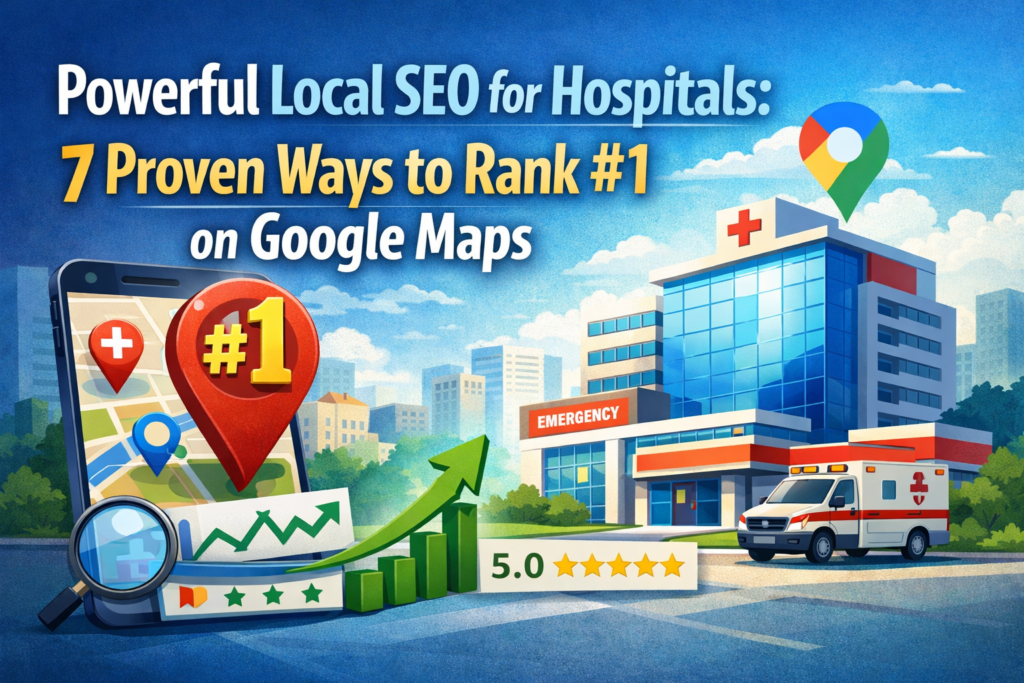
Local SEO for Hospitals — 7 Proven Ways to Rank #1 on Google Maps 2026 Local SEO for Hospitals · 2026 Guide 7 Proven Ways HospitalsCan Rank #1 onGoogle Maps A futuristic SEO playbook to help hospitals dominate local search results, attract more patients, and grow in 2026. 8 min read Updated 2026 7 Proven Strategies AI-Powered Insights Google Maps Local Keywords SEO Content Backlinks Patient Reviews Mobile SEO Dept. Pages Blog Content AI SEARCH RANK #1 GOOGLE MAPS +75% VISITS LOCAL PATIENTS 7 STRATEGIES PROVEN 2026 ORGANIC SEO ZERO AD SPEND AI-POWERED HEALTHCARE SEO NETWORK · MADURAI 2026 🤖 AI Healthcare SEO Network Visualization Contents Why Local SEO Matters Google Business Profile City-Based Keywords Department SEO Pages Google Reviews Healthcare Blog Content Local Backlinks Mobile-Friendly Website Today, most patients search online before visiting a hospital. When someone searches “hospital near me” or “best ENT hospital in Madurai”, Google shows local results and Google Maps first. If your hospital does not appear in those results, you are losing potential patients to competitors. This is why local SEO for hospitals is extremely important — it directly increases appointments and patient visits. 70%Healthcare searches on mobile devices #1Maps position drives most walk-ins 7Proven strategies in this guide 01 Google Business ProfileOptimize Your Google Business Profile One of the most important steps in hospital local SEO is optimizing your listing on Google Business Profile. This profile appears in Google Maps and local search results whenever patients search for nearby hospitals. Hospital name, address, and precise location pin Phone number and website link Opening hours including emergency hours Correct hospital category and services listed High-quality photos — building, doctors, reception, facilities A well-optimized Google Business Profile is the single most impactful step a hospital can take to appear in the Google Maps top 3 results. 02 Keyword StrategyUse City-Based Keywords Local keywords play a huge role in healthcare local SEO. Patients search for hospitals using location-specific terms. Including them naturally in your content helps search engines understand where you operate. Best hospital in Madurai ENT hospital in Madurai Kidney hospital in Madurai Diabetes treatment Madurai Website headings and page titles Blog articles and service descriptions Meta descriptions and image alt text 03 Website ArchitectureCreate Separate SEO Pages for Each Department Many hospitals make the mistake of having a single webpage for all medical services. Search engines rank websites better when each service has its own dedicated, detailed page. Cardiology Hospital in Madurai Orthopedic Hospital in Madurai ENT Hospital in Madurai Gynecology Hospital in Madurai Nephrology Hospital in Madurai Each page should include detailed information about treatments, doctors, facilities, and patient benefits to improve both user experience and SEO performance. 04 Reputation ManagementCollect Positive Google Reviews Online reviews strongly influence Google Maps rankings. Hospitals with more positive reviews appear higher in search results because reviews increase credibility and trust signals to Google. Send review links via SMS after successful treatment Place QR codes at reception and discharge desks Ask patients politely after a positive consultation Respond professionally to all reviews — positive and negative Positive reviews not only improve search rankings but also give new patients the confidence to choose your hospital over every competitor. 05 Content MarketingPublish Local Healthcare Blog Content Regular blogging is a powerful strategy for improving hospital local SEO. Healthcare blogs help hospitals answer patient questions and appear in more search results consistently over time. Early symptoms of kidney disease Diabetes prevention tips Heart health tips for adults When to visit an ENT specialist? Best foods for heart patients Signs you need orthopedic care When hospitals publish helpful blog content, search engines recognize the website as an authority in healthcare information — increasing traffic and attracting more potential patients. 06 Authority BuildingBuild Local Backlinks Backlinks are links from other websites pointing to your hospital website. They act as trust signals for search engines, helping your website rank higher in search results. Local news websites and media outlets Healthcare directories and medical portals Medical associations and health boards Local business listings and city directories Health blogs and wellness publications 🔎Google Search ConsoleTrack impressions, clicks & backlinks 📊Google AnalyticsMonitor traffic sources & behavior 07 Technical SEOMake Your Website Mobile Friendly More than 70% of healthcare searches happen on mobile devices. If your hospital website is slow or difficult to use on smartphones, users will leave immediately — hurting rankings and losing patients. ⚡Fast Loading 📱Responsive Design 🧭Easy Navigation 📞Click-to-Call 📋Appointment Forms Google’s mobile-first indexing means your mobile site is what gets ranked — a fast, responsive hospital site is non-negotiable in 2026. Final Thoughts Start Ranking Higher in Local Search Today Local SEO has become one of the most effective digital marketing strategies for hospitals. When implemented correctly, it helps hospitals appear in Google Maps, local search results, and nearby patient searches. Hospitals that invest in local SEO today will attract more local patients and build stronger trust in their community. Google Maps Top 3 More Local Patients Stronger Community Trust Higher Appointment Rates Long-Term Organic Growth Zero Ongoing Ad Spend Ready to Dominate Local Search? Hospitals that invest in local SEO today will attract more patients and build stronger trust in their community. Let’s get started. Get Started with Healthcare SEO →

Scroll to Top