
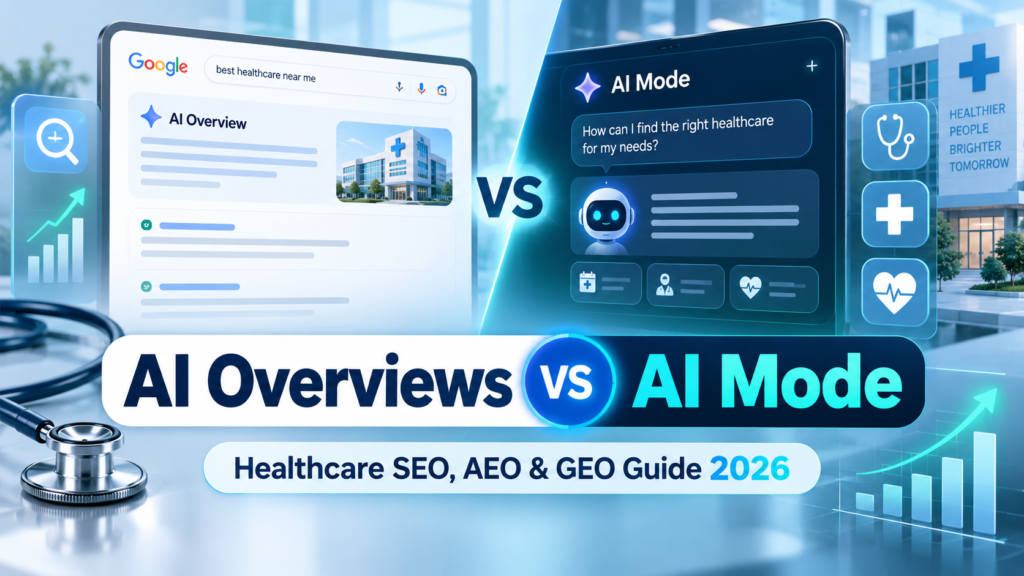
AI Overviews vs AI Mode: Healthcare SEO, AEO & GEO Guide 2026
AI Overviews vs AI Mode: Healthcare SEO, AEO & GEO Strategy 2026 | Minmini Digital Marketing Healthcare SEO • Google 2026 AI Overviews vs. AI Mode: The Unified Search Strategy Healthcare Needs Now How hospitals, clinics, and healthcare marketers can win visibility across Google’s converging search ecosystem — using SEO, AEO, and GEO together. 14 min read Updated September 2026 Minmini Digital Marketing, Madurai Scroll Overview Google Search is no longer a list of links.It is an information journey. AI Overviews provide the initial synthesis. AI Mode enables deeper exploration. Featured snippets surface concise answers. Organic results supply supporting resources. And increasingly, all of these experiences connect to one another. During 2026, the distinction between Google’s AI Overviews and AI Mode became increasingly blurred. Google introduced a seamless transition allowing users to move directly from an AI Overview into an AI Mode conversation while preserving the context of the original search. More recently, Google confirmed that some AI Overviews can dynamically expand into longer responses — making the main Search interface look increasingly similar to AI Mode. For hospitals, doctors, clinics, healthcare publishers, and healthcare digital marketers, this change has major implications. Winning visibility is no longer simply about ranking a webpage for a keyword. Healthcare websites increasingly need to become a trusted source that Google can retrieve, understand, summarise, and cite — across traditional search results, featured snippets, AI Overviews, and conversational AI search experiences. “Stop optimizing for AI Overviews, AI Mode, featured snippets, and organic rankings as completely independent channels.” Google Search Ecosystem — 2026 Guidance The Two Surfaces AI Overviews and AI Mode — What Exactly Is the Difference? Google still describes AI Overviews and AI Mode as distinct Search features, and its documentation notes that they may use different models or techniques, and therefore may show different responses and links. However, the user experience is increasingly unified — and for SEO teams, the practical lesson is clear. Surface 1 Google AI Overviews AI-generated summaries displayed within Google Search that provide a quick answer to a user’s query along with links to relevant web sources. They typically appear when Google’s systems determine that a generative answer will add value beyond conventional results. For healthcare websites, AI Overviews create two opportunities: rank in conventional organic results, and become one of the sources supporting Google’s generated answer. Surface 2 Google AI Mode A conversational search experience designed for complex questions that require deeper research, comparisons, reasoning, and follow-up queries. Instead of performing only one search, AI Mode can break a question into multiple subtopics and search across them simultaneously — a query fan-out approach. Google reported in May 2026 that the average AI Mode search in the US was approximately three times the length of a traditional Search query. 3× The average AI Mode search query is approximately three times longer than a traditional Google Search query (Google I/O, May 2026) Why Healthcare Is Different YMYL + E-E-A-T: The Non-Negotiable Foundation for Healthcare Visibility Healthcare belongs to Google’s Your Money or Your Life (YMYL) category because inaccurate medical information can affect a person’s health, safety, and wellbeing. Google says its systems place greater emphasis on signals associated with strong E-E-A-T for YMYL subjects. Among these four dimensions, Trust is the most important. A generic 2,000-word article produced simply to target “best treatment for knee pain” is not enough. Google needs reasons to trust who wrote the content, who medically reviewed it, where the medical information came from, when it was last reviewed, whether claims are supported, and whether the website represents a legitimate healthcare organisation. E Experience First-hand experience with the topic. Original clinical resources, procedure videos, real patient preparation checklists. E Expertise Medical knowledge and qualifications. Content authored by doctors with verifiable credentials and clinical specialities. A Authoritativeness Recognition by peers and established institutions. Citations from recognised professional associations and clinical guidelines. T★ Trustworthiness The most important signal. Accurate, qualified language; transparent authorship; verifiable sources; legitimate organisation identity. The Three Disciplines SEO, AEO, and GEO: Distinct Disciplines, Unified Goal For healthcare websites navigating Google’s AI search ecosystem, these three disciplines are no longer separate concerns. They increasingly overlap — and the winning strategy is to deploy all three together. SEO Search Engine Optimisation Helps search engines discover, understand, index, and rank your content. Traditional SEO remains the foundation — Google explicitly states that existing SEO best practices continue to apply to AI Overviews and AI Mode. Crawlability, Core Web Vitals, internal linking, and authority building are prerequisites, not optional extras. Keyword Research Technical SEO Core Web Vitals Local SEO Authority Building Mobile Usability AEO Answer Engine Optimisation Focuses on making information easy for search and AI systems to extract as a direct answer. The structure is deliberately clear: question, immediate answer, supporting explanation. This format works for users and also provides an identifiable answer passage for Google’s systems. Particularly useful for definitions, symptoms, causes, comparisons, “when to see a doctor” questions, and step-by-step information. Direct Answers FAQ Structures Symptom Guides Definition Pages Snippet Formatting GEO Generative Engine Optimisation Focuses on making your content understandable, trustworthy, and useful enough to be retrieved or referenced by generative search systems. Healthcare marketers should avoid treating GEO as a secret technical trick — Google’s official guidance states there are no special technical requirements exclusively for appearing in AI Overviews or AI Mode. Strong GEO begins with strong SEO, useful information, and clear entities. Unique, non-commodity content is the real differentiator. Entity Clarity Structured Data Original Research Medical Review Trails Non-Commodity Content 10 Ten strategies for healthcare visibility in Google’s AI Search experience — each grounded in building genuine trust, not gaming algorithms. 10 Strategies Optimising for Google’s AI Search Experience: A Healthcare Playbook 01 Build content around patient questions, not just keywords Move beyond single-keyword pages to complete topic entities. Instead of targeting only “Knee Replacement Surgery Madurai,” create a connected resource covering what the procedure involves, who may need it, how long recovery takes, what tests are required, and what